Showing posts with label Wildlife. Show all posts

Sunday, March 7, 2010

Big Brown Bat - our neighborhood night flyer

I ran across a Big Brown Bat on the street last night, right at dusk. It had apparently escaped the talons of an owl, punctured in the chest by a talon. It soon died on the street after trying valiantly to recover and fly off. I feared it could have rabies, like many residents tend to do, so I ran home and got my camera and some gloves and something to carry the animal. On my return to the site, it had already died, looking more like a glob of mud on the ground than a mammal. I did retrieve the bat, placed it in a bag and took it home. 

After calling agencies to find out the appropriate action I should take, it became apparent that no one of authority was concerned about rabies nor was there any advice except to bury the creature. Rabies is not as prevalent in bats as we might think. That is what makes the news, but the risk is not so much a reality. So after calling,  I took a few photos and buried the creature.

The Big Brown Bat does not have prominent visible teeth like some bats. It is a very common bat species. It can number 1000 in one forest group. Here, there is no telling where its family might be, only that it should be very close-by, considering the time of day that I found it. I know of one home in this neighborhood that has a bat house attached to it. Maybe that was its habitat.

Our forests are amazing. They contain a large diversity of animals and plants.

Friday, March 5, 2010

If you find a fawn ...

The grass is turning green, the flowers are starting to bloom and in the Montgomery County area, babies are being born to wild creatures.

Friends of Texas Wildlife is a non-profit organization that rehabilitates orphaned and injured wildlife. It is often called upon to help what appears to be an orphaned fawn when, in actuality, it’s not orphaned at all. Fawns are often left alone for several hours while the mother is looking for food. Here are some tips to help you recognize if a fawn needs help. If a fawn is obviously ill, lying on its side, kicking, crying or is covered with fire ants, pick it up and place it in a box or animal carrier. A light cloth placed over the animal's head will sometimes calm it. Keep it away from pets and all human activity. Petting the fawn, talking to it or holding it does not comfort it. This is a wild animal. Human voices, odor and touch only add to the stress and will cause additional harm. DO NOT FEED THE FAWN ANYTHING. Call Friends of Texas Wildlife at once for help.

If an uninjured fawn is seen, leave it alone and leave the area. The fawn would not be there if the doe were not nearby. You will not see her mother. She will return for the fawn only when there are no humans near. If you have removed the fawn from its resting spot, TAKE IT BACK AT ONCE and walk away.  The doe will be searching for her fawn and will accept it even with human scent on it.

In general, it is not a good idea to make a wild animal your pet. Not only is it not fair to the animal, it is against the law. According to Chapter 63, Section 63.002 of the Parks and Wildlife Code, no person can possess a live game animal (deer are game animals) for any purpose not authorized by their code. The first offense for illegal possession of a live deer is a Class C misdemeanor punishable by a fine of up to $500 plus court costs. There are similar laws for possession of other animals such as raccoons.

The picture you see was taken in someone’s yard in the Lake Windcrest subdivision off of FM 1488. Apparently, someone thought this fawn was abandoned and decided to make it their pet. After it was collared and leased, it escaped and was seen running throughout the subdivision. Its chances of survival in such incidents are extremely slim unless captured and turned over to a permitted wildlife rehabilitator.

If you have questions about what to do if you find an animal in your area or even in your attic, call FRIENDS OF TEXAS WILDLIFE at 281-259-0039 or check their website at www.friendsoftexaswildlife.org.

My neighbor once found such a fawn here in The Woodlands.  He brought the animal for all to see in the cul-de-sac. It was found in a green area on the other side of his fence. It did not move when his dog kept barking at it. So my neighbor reached over the fence and [picked it up. It came alive and fought back. It was only obeying its mother to stay there until she returned. I asked him to return it, as advised by Friends of Texas Wildlife.  We never knew the final disposition of the creature, but I suspect its mother returned to fetch it.

Friday, February 19, 2010

The Baby Eagle - wild and free from the start

An Eaglet is wild from the start. Think a second about its life. It hatched in January, about the coldest time of the year in this nesting territory. It is a carnivorous creature from day one. At the start, the parents kill the creature it brings to the nest, but after a while, doesn't bother anymore. An eaglet tears the meat with its sharp beak and claws, then gulps it down.

Although I do not have a photo of that process, I have witnessed it. The meat is tossed in the nest and the eaglets feed off of it for a fairly long period of time, if its food is of any significant size. For example, it could be eating possum, rat, fish, cat, rabbit or dog for dinner. The parent can pick up and carry a 10 pound animal to the nest.

This baby bird is about 4 weeks old in my estimate. It is very interested in what is found outside of the nest, inquiring on everything that is happening in the forest. He is aware that I am near; his parents have warned him. The glow in his eyes seem to indicate his desire already to leave the nest and fly free. Freedom rings in the Eagle. His posture is exactly that of a grown bird - one of astuteness, overseer, ruler of the forest, serious and highly perceptive, with far reaching eyesight.

I think it is worth an extra click to see the full size photo.

Tuesday, February 9, 2010

Family life of a Bald Eagle

Observing a family over the past couple of years in the forest of East Texas, I have grown emotionally attached. I think many people see their responsibility for the diversity of life on our planet. As a co-resident of our planet, a human and an Eagle share instincts developed through natural survival evolution through the ages. In the Bible, we are told that man has the responsibility to care care for what God provided upon this planet. We are placed here to make sure his work is kept in tact. It is a huge responsibility that we carry on our shoulders.

Take this Eagle family for an example of the human / creature connection. The Eagle will tolerate human presence but its family life is, after all, what is most important to him. Both male and female share the responsibility of the nest.  This youngster is being cared for by one of its parents. After bringing a small animal to the nest, the parent leaves the animal with the children in the nest. One of the eaglets can be seen here in the nest. The parent has done the work, provided food for the baby and now is enjoying the wind and warmth of the sun, cleaning itself while being close to the eaglets in the nest.

Sometimes, a parent must just watch out for predators such as a vulture, owl or a tree climbing coon.  Life is dedicated to raising the eaglets. Typically, we find two eaglets in each nest and the eagles will raise only one family each year. They arrive in late December and prefer to use an existing nest. It takes a lot of effort and time to build a new one from scratch. I have seen three nests for this couple over the years I have lived here. I am assuming the same birds are nesting at this spot but no one knows the age of the birds.

Duties as a sentry also requires flight over the neighborhood to see what may be on the ground and to observe any threats in the distance. Reconnaissance flights are also needed to find close and easily caught food. A parent is always close. Maybe we don't see them all the time, but they will fly at very high altitude to find food. They see us and we have no idea they are there. "Eagle eyes"  are well known to be highly developed for long distance precise vision. Their hearing senses are also excellent. Each time I have walked through the forest near a nest, they appear after I hear some calls. (See the Call of the Eagle).

So how attached are they to their young? This is one of the amazing features of the bird to me.  After caring for them day and night in the nest, they then teach them to fly, catch their food and then raise families. This is accomplished over about two years. The eaglets will migrate with their parents to the north during the summer and learn the places and means to make the journey. Up north, they continue to learn how to fish and catch animals with the help of their parents. This is one of the few birds that migrates south for the winter to nest, so when December comes, they fly back with their parents, another lesson in making and surviving a journey back to their nesting habitat.

As a sentry, the bird does not care what direction it faces. He can see in all directions from one perch position. He can turn his head more than 180 degrees and has peripheral vision to boot!

I have seen one of last year's eaglets, not full grown adults but not yet with full color, near the nest. Staying close to mama and daddy, it is content to fish and hunt with them until time to migrate back north. Then it will likely fly alone or with his sibling as this family will be caring for the two new eaglets needing their full attention all the way back north. They may find nesting locations near here but not likely very close because one of the criteria is to have plenty of range for hunting, not too near other families. However, our area certainly has its possibilities, with the new Lake Paloma and tree stands on Spring Creek. A second family started nesting here last year. I do not have any information on that nest this year.

The Bald eagle is a tremendous example of a responsible parent to us, working hard to ensure the best outcome and life for their youngsters. The Bald Eagle is truly a survivor and has been coming back strong in recent decades as a genuine and respected resident of many communities like ours.

In Central Texas, near Austin, there is a nesting couple that can be seen from the highway through binoculars. It is far enough away to not be bothered by visitors, but clearly visible. If anyone wants to know where that nest is, I can provide the information. Visiting that nest will not impair the family life of those birds.  Photography is feasible there with a long or strong zoom lens. 

Monday, February 8, 2010

Is an Eagle dangerous?

With three Bald Eagles in my vicinity one day last week, and with one suddenly bearing down on me in the forest, I asked myself a simple question. Should I be here around their babies alone, without a witness or anyone to warn me of danger? So I came back to the computer to learn that there are a few recorded incidents, but mostly with children. The sharp talons of an Eagle are capable of inflicting damage but an adult human is more able to incapacitate an Eagle than a small child.  It is highly unlikely that an Eagle would attack any human. Very few incidents have been recorded. Although the bird is huge, it does not weigh much. There are many incidents with an Eagle attacking small pets and they can carry rather heavy objects, a 15 pound dog, for example.
 
Seeing one flying directly towards you can give a person a strong rush! One is put into a state of awe while at the same time, sensing power and danger just moments away.  The bird is super fast in the air and is incredibly skilled in its flight, dodging tree branches and flying in relatively small spaces, as affords the typical forest. 


  The bird leaves its position on a branch with little warning and no sound. Literally a moment, just a blink, it has totally disappeared right before your eyes. I never feel actually threatened, but can be a little uncomfortable when I know the Eagle is looking directly at me and assessing every move.  So for my purpose here, I have to say that an Eagle is not dangerous. It knows man can hurt him and it prefers to stay out of the way. However, I would never ever threaten one of their babies!

Monday, January 25, 2010

Mountain Lions - in Montgomery County?

I am a Cougar fan (UofH that is). Therefore I have had an interest in this animal as a UofH alumni for years. Cougars are known to be a dominant carnivore on our continent. I have never heard of anyone spotting an actual Cougar in our parts lately, but that does not mean they are not here. A few years ago one was sighted in Sam Houston National Forest in our county. Another was reported neat the national forest some 20 years ago. The animal is reclusive and tends to be nocturnal, consistent with its primary prey, the deer.

In fact, this cat which weighs between 70 and 150 pounds has been sighted and confirmed as a resident of this county sometime in the past. Could we see one in The Woodlands? Anything is possible, but I seriously doubt we will ever see one here. The reclusive Mountain Lion is not a huge threat to humans and coexist among humans from the tip of South America to the more northern reaches of our continent.  Almost every county in Texas has a confirmed sighting of at least one, including ours. Where deer live, the Cougar is also a candidate to live there. The Cougar is the top of the food chain, with the Coyote sharing that fame secondary. Due to its size, the Cougar is the most feared adversary of the Texas deer.

Similar to the Coyote, this animal is beginning to learn  how to hunt and avoid man as open land becomes more scarce. Ranchette-type subdivisions of 10-20 acres can expect to see this animal at times. There is an excellent field guide produced by the Texas Parks and Wildlife on this animal if you get the time to read a full explanation of its habits, threat, how to react if you are confronted by one, footprints and life style.

A Field Guide to Texas Mountain Lions

The Cougar is considered a dangerous animal if raised in enclosures and kept as domestic animals. There are county laws related to this. Those laws do not apply to free animals in the wild. All "kept" wild animals must be registered with the county. Therefore, if you see or know of the presence of a  Cougar, the animal could be the registered property of someone else. The proper thing to do is to report the sighting to the Sheriff's office or animal control.

Montgomery County Wild and Dangerous Animal Regulation

References
1. Texas Parks and Wildlife website - Nuisance Animals : Mountain Lions
2. Montgomery County Wild and Dangerous Animal Regulations

Monday, October 12, 2009

Tree Rat Nesting Season in The Woodlands

Each year in this neck of the woods, our forest rats search for a place to nest. They like to come to the homes where it is nice and cozy during the winter. If they can get in, they will nest under boards or in some quiet place in the attic. We often respond by calling our favorite pest control company. Some of us try to solve the problem ourselves. What to do?

Unfortunately many of their natural enemies are removed and relocated elsewhere. The Coyote is our best friend for controlling the rat. Owls are also a good predator but we do not have many anymore - lack of trees and space. Since rats are night creatures, their enemies are typically out hunting when the rat is out foraging - night time!

Every year, I am confronted with some sort of rat issue. Last year, they managed to get in the garage, so I had to deal with them there. They had a litter and I had to capture as many as possible. What I did not get, I ended up poisoning. That irradiated them well. They made a mess before I could get them out. To prevent them from returning, I  replaced the bottom seal of both garage doors. Yes, all it takes is a very small opening and they can squeeze through it. About two years earlier, they had found a way to get into the attic through a small opening on an eve of the house. I found that by going up into the attic, turning off all artificial lights and finding where the light was entering the attic. I filled the space with a can of spray Styrofoam and painted it. That worked well. Now we have no light entering the attic.

Last night we heard some gnawing again. This was the second night during the past week that we were awaken by some creature. I went outside and could find nothing of course. So I decided it was probably a rat. The weather and time of year are both perfect for them to be trying to get inside. I know we have Opossum outside regularly but believe this time, the problem is that rats are trying to find a way into the house or possibly are already inside. So I bought a new type of trap and baited two of them - one outside and one inside. The outside one is portable, wired to whatever is available. I screwed down the inside trap because I do not want one to grag the trap into a wall cavity.

We have found that we can endure a dying rat in the wall, but it is not the most pleasant thing in the world.  No perfume or air deodorant helps. It just stinks for about two weeks.  Ventilation is the best tool - a fan in the area with one of those heated deodorant systems. Just don't invite guests! The alternative is to cut out the wall and remove it, if you can find exactly where it is. There will be flies in the house also, so there is a possible health issue in leaving the animal to decay naturally.

Chances are you have seen one of these animals at night or in your yard, especially if you have bird feeders or feed your dogs outside. I have seen them in the trees but very seldom see them crossing the street at night. The less timid Opossum is more likely to be in the street than the rat.

A Tree Rat in the East Texas forest will forage around for almost anything to eat, especially grain, insects and fruit. The forest has an abundance of food in the summer. In the winter, especially when much of the ground is covered in water, a rat will search on higher ground or in plants.  Nearby wild rats tend to come out of the creek bottoms and go up where homes are built because it is dryer and its food tends to do the same. Closely following the food chain would be the Rat Snake and the Coyote among others. Today, the rat is finding itself at the top of the food chain, much to our demise. We kill or remove the Coyote. Many humans despise all snakes, so the snake is on the decline as well.  If we feed the birds, we feed the rat as well. If we feed the squirrels, we are feeding the rats as well. Their olfactory senses are keen. They can smell the presence of other rats, many types of chemicals and can even smell individuals of their own kind like a dog. The can even sense change by their smelling senses. The results in rats returning to the same place they were born and socializing enough to bring in other individuals to their abode. So having scat about the house provides a means to communicate among individuals.

So we conclude with some advice on removing them from the premises. I do not advocate a catch and release strategy. The next best thing is to physically kill them with a good trap. Don't use the old type of rat trap. There are newer kinds that produce more of a quick kill rather than allowing the animal to suffer for a long time. After seeing what the animals go through with poisons, I do not recommend a slow death using that strategy either. Rats are very smart. They rarely get into things they cannot get out of. A poor trap will allow a rat to be trapped with its tail or a leg. The rat will bite off a leg to free itself. They also learn by observation. When they see another rat trapped or killed by a device, they will avoid it. Two types of traps are recommended - the electrical (expensive) trap serves the best purpose. Second choice is called the Snapper. It is a strong heavy plastic trap that can be attached to wood by a screw. It's food cup can be removed to clean or put load the bait.  My portable unit is tied down with a string of wire. My permanent trap is screwed into the attic floor. Let's see how fast I can remove these creatures this year!

Good luck with yours.

Wednesday, September 2, 2009

Broad Banded Water Snake

The Broad Banded Water Snake is one of seven nonpoisonous water snakes found in Texas. 1 It is readily identifiable as this one (sorry for the poor quality. Will try to replace the photo later with a better one) was at Mercer Arboretum, near The Woodlands Texas. They live in trees, on the ground and in the water, searching for food. When small, they eat small fish by roaming the water with their mouth open. As they get larger, they move on to frogs and small shore creatures. This snake is harmless except it will bite like all snakes. In its mouth it excretes an anticoagulant, so a bite can take a few minutes to stop bleeding. It is not a poisonous venom. This species is sometimes considered to be a pet growing up to about 3 feet. It can be handled with care. However, it belongs to the wild and should stay there. It matures in three years and produces live babies. One will often find a banded snake within 50 feet from the shore of a lake, river or creek, or swimming in the water. Remember though that all snakes can and will swim. Not all snakes climb. Rarely does a poisonous snake climb into trees. The Banded Water Snake will oftentimes be found in limbs of trees overhanging a body of water.

References:
1Watersnakes

Monday, August 10, 2009

A huge day spider - commonly seen in The Woodlands and elsewhere

Here in The Woodlands, I have seen this spider of the family Araneae several times before. It is the Black & Yellow Argiope, or Argiope aurantia. It is very big and scary to many people. Go to swampy areas in Southest Texas and you might find these in abundance. These were found on plants next to a pond in a Woodlands park. This large one is the female. Although like most species of the family, its bite is venomous but not dangerous to a human. It eats small insects captured in its web.

The small one is the male.

Saturday, August 8, 2009

My kids call them Bambis


In The Woodlands, my children call a Texas White Tailed Deer "Bambi". "Look, Bambi's". They are not little children; they are teenagers. But it tells us the special place deer have in our society and hearts. Walt Disney made sure of that! This morning, I went to photograph a park. On the way, one doe ran across Lake Woodlands Drive. It was not so early, so I was not expecting that at 7:30AM! That woke me up. The doe disappeared quickly into the forest.

After photographing a park, I started home. On crossing the Bear Branch Creek bridge on Research Forest Drive, I spotted a beautiful buck down on the creek along with several does. Since I had the camera on this outing, with all the necessary gear, I decided to park and walk back to the creek. On doing so, as soon as I could see the area below the bridge the buck also spotted me. He ran; I hit the shutter button. Then he paused for a second, as if to satisfy a curiosity. "What was that noise?" I clicked again. He ran again. So you have the story behind these two photographs. I rarely have my cameras with me on these occasions, but this time yes!
When I used to take my daughter to the Woodlands High School, we would see deer grazing, usually on foggy mornings. Last night, we had a full moon early. I suspect that the deer wanted to feed late in the morning because it turned dark fairly early as well. Notice the ribs showing on this beautiful creature. The drought has been tough on their lives, but there is plenty of grass. Water may not be so abundant however. I noticed a few weeks ago that water was indeed much less abundant than in the past when I was on the creek. My brother, a hunter, tells me that a rack like this indicates a healthy deer. Perhaps there is a lack of protein due to the green grass it is eating. Bambi is alive and well here in The Woodlands.

Wednesday, June 17, 2009

Red-Cockaded Woodpecker at Jesse Jones State Forest

Do you know we have a true living forest next to The Woodlands, Texas? There are 43 counties containing parts of the East Texas forest system. The significance of this conservation next to us is quite important. When entering the forest, you will recognize a vast difference between going into the managed logging forests such as The Woodlands and this managed forest.You generally won't find the same along Spring Creek either, because much of it was part of the logging forests, or fires have been prevented and there are no clearings. In the logging forests, the short needle pines were planted in place of the native Long Leaf pines. Those pines are faster growing and produce more wood, giving investors a higher return on their investments. We do find the Long Leaf Pine in some places, but the predominate species in our area now is the Loblolly Pine.


The Long Leaf Pine is more susceptible to disease than its brother the Loblolly. Jesse Jones National Forest is populated with the Long Leaf. The forest is "fire maintained". That is, the density of the forest is controlled with planned clearings to enable the sun to reach the ground, a necessary condition to maintain the natural native ecology. Various species of creatures depend on the natural ecology and native plants which thrive within the boundaries of this forest. It is believed that there were many frequent fires in the forests which continuously reconstructed the ecology that is now maintained through a forest management process within Jesse Jones.

One such creature is the Red-Cockaded Woodpecker (RCW). It is one of eight native species of woodpeckers in our East Texas forests. It shares its habitat with the Red-Headed Woodpecker and other woodpeckers we see right here in The Woodlands. It is unlikely but possible to see the RCW in The Woodlands, since Jesse Jones Forest is so close. The bird is found on private lands and in some areas along Spring Creek. However, there are no places for the bird to nest here. Each year, there is a formal national bird count conducted in December to watch and mitigate extinction. It's range in Texas was the entire East Texas forest system. Today, only 13 counties report significant sightings of nests; 15 counties no longer have the birds at all. This woodpecker is found and protected in several southeastern states. Some 6500 birds survive the wild today.


This woodpecker species is on the endangered list. In past centuries, it inhabited all the East Texas forest. Then, forest consisted primarily of Long Leaf pines, with an understory of grass on the forest floor. There were not many hardwoods in the forest, primarily due to frequent fires. RCW (Red-Cockaded Woodpecker) requires a mature pine tree with a disease that comes in that maturity. It does not nest near a hardwood. The disease is "red heart disease, a fungal infection that causes the core of the tree to rot. In Longleaf pines, trees do not begin to suffer from red-heart fungus until their age averages 80 - 120 years old. Once a suitable, mature tree is found, it generally takes an RCW 1-3 years to construct a cavity. Generally these birds will excavate groups of cavity trees in an area (called a cluster)."1 The disease softens the core, enabling the bird to carve out a cavity for its nest.


This photograph was taken of a nesting tree in Jesse JOnes Forest right after a family of the birds fledged from the nest in 2009. This Longleaf at this location is found among several of one cluster in the park. Note the holes about 30 - 35 feet high on the tree. Only one of the holes was the nest of a family this season. All of the baby birds have left the nests but will be building new ones for next year. Sap produced by the tree is released by the excavation of the cavity and said to be a natural barrier to the birds' enemies. If a hardwood is nearby, there is danger of a Rat Snake climbing up into the nest, discouraging parents from raising a family in the tree.


So we see a little bird with a specific ecological need, being protected in Jesse Jones Forest, right next door. Hopefully I will acquire a photo of this shy little bird in the near future and expand on this subject.


References

1 The Long Leaf Alliance, "A Family of Red-Cockaded Woodpeckers Makes a Home in a Mature Longleaf Pine Tree",

Friday, May 8, 2009

Tennessee Birds - common species


While investigating the forest, I focused a while on the birds. This is a time consuming task, to photograph birds that is. Most of the birds viewed there were the same species as here in The Woodlands, with a few slight twists. The bird above is the Cedar Waxwing. It is migratory and was in the trees in an apparent migration north. They were stripping the trees of seed pods. It was a feeding frenzy!


This little guy is a Kinglet but not sure of exact identity.


This colorful little fellow is a Rufus-sided Towhee.


Another colorful bird I saw plenty of but got few photos, was this Red Breasted Nuthatch above. It was nesting near the cabin. in the BBQ pit. Notice the food it brought to feed its babies.

Here was one of the brightest Cardinals one can ever find. You can see that it was nesting time. Already the birds here in The Woodlands are looking a bit shabby from raising their young.
We have seen this bird time after time in the piney forest. They are also common in Tennessee - the Carolina Wren. This was found near the cabin, feeding in the front yard.
This is a nest of three nuthatch chicks (one flew out). They other two flew out when the flash went off but returned to the nest the next morning.

Tennessee Forest has character and wildlife


I know, this is not supposed to be here in this blog. I confess, I love more forests than that found here in southeast Texas, so this is placed here to remind us of the many sites we can go to appreciate nature in these United States. I got an opportunity to experience my second early spring of the year. Early Spring was long gone in southeast Texas in late April. Here, the land was in full bloom.

Like most forests, one can find some incredible character in the Tennessee forests. Although there is limited and diminishing space containing natural virgin forest, we find many small connected tracts of land sustaining wildlife and ancient timber. Wildlife, as we know it in America, requires considerable space to thrive. Deer, antelope, turkey, and many other creatures will naturally move about seeking mates, food and water, in different seasons of the year. They can't be constrained to a small farm space. I was fortunate recently to stay a couple of nights on a 40 acre private tract near the Kentucky border, connected to other private tracts where the wildlife is highly valued. My observations were from the eyes of a lover of forests, wildlife and trees.
Unlike our pine forests in Texas, this is definitely hardwood country. It has a smattering of oaks, hickory and many other species to form a canopy. Underneath that canopy is a diverse life of trees and bushes, some of which we are familiar with here, such as the Flowering Dogwood. The dominant Dogwood is the white bloomer, but the pink is also found among its canopy trees.
A casual visit to this land is just not enough time to soak it in. Each time I ventured out to photograph, I would see something totally new. From a photographer's view, what you see has everything to do with the light - angle, intensity, color. Early morning is dramatically different than late evening and mid-day with the sun shining, presents the forest "in a totally different light". At times, I ran across varied bird species that I wanted to photograph but could not, because they usually were too shy and elusive to capture with any quality.


This waxwing was one of hundreds feeding on fresh spring seeds in this tree.

Configurations of trees in the forest make interesting scenes. This one caught my eye as I was looking for birds. This place was full of birds, but my eyes met up with the tangled limbs and fauna on the trees and the ground.

To get to these little farms, one often must find the small lanes through the countryside. However, be warned. Everyone participates in informal neighborhood watches. Land owners all have guns and are willing to use them on trespassers.

Deer are plentiful and often large, much larger than our little ones. These were grazing behind the cabin and I photographed them through a window of the cabin.

Turkey are also plentiful. This was during hunting season and we were watching four hens and a gobbler on the slope of this hill.

Thursday, April 2, 2009

And the Woodlands Eagles Fully Fledge

They have left the nest! Still nearby, but now enjoying their new-found freedom over the forest. Today, I came up on one perched on a tree limb fairly low to the ground. He was a little rustled by the strong winds, gripping the limb tightly with his talons. His sibling was flying over part of the forest nearby while he seemed to be just resting for the day. No parents were flying nearby for the short time I was observing them.
I did catch the first view of him flying but did not capture it well with the camera lens. He was flying at a very fast speed with the wind. I am presenting the photo anyway.

Both young birds were enjoying their mobility and showed signs of advanced training by soaring through the tree tops. They will be hunting soon.

Thursday, February 12, 2009

Afraid of snakes and you live near The Woodlands?

Even if you do not live near The Woodlands, this is probably for you. The East Texas piney woods is not a dangerous place for snakes. Here in The Woodlands, we cautiously look for only three venomous snakes and only one is really of much concern. Not bad considering there are some seventeen snake varieties expected to be seen in this area! Learn these three and you have it made. There is possibly a fourth venomous snake that might be seen, that is on the endangered list, but I really doubt any of us will ever see it. I will also describe it here nevertheless.

First be safe outdoors. When gardening, wear gloves when working in in and among vegetation. For clothing, wear long pants and shoes. Don't allow children to play outside barefooted. These are practical safety tips for everyone irregardless of what we do outside. Stepping on a rusty nail is probably more apt to occur than running across a snake. Snakes do bite and they can hurt but most of the time, that is all there is to it. Still, be safe and if you or your child is bitten, go to the clinic. Don't panic, just casually go there to have it looked at. The staff will want to know what the snake looked like. If you know your venomous snakes, you already know whether the snake is venomous or not. Chances are even if it is venomous, there is no venom in your wound.

Speaking of risk, do you know how many fatalities we have each year in Texas as a result of a snake bite? We average less than one per year for the entire state. Those usually occur in the hill country or in West Texas or on the coast. (Be careful in the dune grasses of Galveston or Padre Island - rattle snakes there are very dangerous). I don't believe we have had any deaths in east Texas. But people do get bitten. Many times when people are bitten by a venomous snake, the snake releases zero or only a small amount of venom. They are known to conserve their venom for catching prey. They know you are not food and they need to eat! A baby snake may be more apt to hurt you, because he probably has not learned yet to conserve his venom.
Courtesy of Troy 1. Click on photo for detailed view. Copperhead.

Let's take a look at the venomous species. It behooves us to learn to identify these three common snakes. The most likely one you are to encounter is the Southern Copperhead. This one is the most populous of the venomous snakes in this area. The key identifying marks are the clear dark patterns that look like Hershey Kisses on the side of the snake, with the tip of the kiss on the top of the back, often touching the kiss on the other side. Another way to look at the markings is to envision an hour glass with the center of the hour glass on the top of the back. Hershey kisses are easy to remember. Characteristically, the snake will be light colored underneath, a light brown base on its sides and top, with fairly sizable kisses on the sides. Our first lesson - Don't kiss a Hershey Kiss snake! In fact, stay clear of it. They will not harm you unless you corner it or otherwise threaten it in some way. Let it be - all snakes have value in the forest. This snake might climb up into a bush looking for food.
Courtesy of Troy 1. Click on photo for detailed view. Adult Cottonmouth.

The next likely problem snake would be the Western Cottonmouth. This one is less populous but very wide-spread and likely to be found on or near the water. This one is a little more difficult to identify. The head is the key to this snake. At some distance, you might see a fully black snake, or a very dark snake with barely visible brown rings or if a young lad, it might have irregular dark rings around a brown body. The rings fade as the snake ages. To confirm your sighting, you would examine the head.
Courtesy of Troy 1. Click on photo for detailed view. Juvenile Cottonmouth.

It will have a dark stripe on the sides of its head, resembling the face of a raccoon. So remember, raccoons don't eat cotton; they just have in their mouth! It is dangerous. Inside the mouth of these slippery creatures are little pieces of tissue that look like cotton. This is not the only snake that has this in its mouth, so use the external head criteria to identify the snake. This snake likes to eat food near the water, such as frogs.

Courtesy of Troy 1. Click on photo for detailed view. Coral Snake.

The less likely snake to run encounter is the most dangerous but not seen very often. Its venom is the strongest. The Coral Snake has a small mouth and has more difficulty than other snakes breaking the skin and even more of a problem trying to get through your clothing. However, its teeth are sharp and given sufficient time, can and will envenom a person. Consider this snake very dangerous and do not touch it or threaten it! This one is colorful, but there are several species that can appear to be a coral snake and are not. Every other ring is yellow. There is no other snake with that attribute, but there are others with yellow rings. The rings are red, yellow, black, yellow then the ring color pattern is repeated. If you see yellow bands in the day, this is it. If you see yellow bands at night, it is another species, such as the King Snake. So remember, yellow bands in the day are dangerous. Stay clear. Just let him be. There is no need ever to harm a snake. He wants to be left alone just as you do.

The only other possible dangerous snake is the Timber Rattlesnake. If you see rattles on the end of the tail, it is dangerous. Always! And the rattlers do make noise.

Other non-dangerous snakes you may see here include: nocturnal Milk Snake (every other band is black), Buttermilk Racer (also known as the Blue Racer), Rubber Snake, Eastern Hognose, Texas Rat Snake, Rough Green Snake, Texas Brown Snake, Rough Earth Snake, Yellow Belly Water Snake (raccoon mask on head 4-4.5 ft), Blotched Water Snake (black with some white), Diamondback Water Snake (5 ft checkered pattern), very common Broad Banded Water Snake (Black and white bands), Western Mud Snake (reds on it with rectangles underneath), Speckled King Snake (looks like small white dots all over it).

Other trivia to know: all snakes can and will swim in water. They know how to survive in bogs and swamps. Mothballs are good to repel snakes from an area.

Acknowledgements

Thanks to Mike Howlett of Houston Herpetology Supply for presenting this material to us. He sells snakes and snake supplies at www.houstonherp.com in Spring, Texas.

1Thanks to Troy Hobbitts for providing his 2006 copyrighted photos of the venomous species to help you visually identify snakes here in The Woodlands.

And thanks to several others who also shared their knowledge of snakes in this part of Texas.

This is an interesting video of a "land snake" swimming in water. A Rattle Snake!

Thursday, February 5, 2009

Great News for Eagle Fans - Woodlands Texas


Bald Eagle fans that is. This year, we are proud to have a second nesting Eagle couple. The returning couple has nested in or near their traditional location on East Shore, and now a new couple has moved into Carlton Woods! I suspect at least one is an offshoot of The Woodlands couple. Fifteen eaglets have been born and raised here over the past few years. They mature into breeding adults at about five years of age and live to be about thirty. It is believed that we have chicks in both nests this year. They usually raise one or two chicks each year. We are now awaiting sightings of the newborns above the nests to see how many we have this year. The new couple have decided that they did not need to be very near water, as did our resident pair. We have watched the Eagles teach their offspring to fly, to fish and even to hunt. They of course soar high and distant in search of food. Each year someone gets the privilege of seeing one or more in a local park or near their home. Each December-January, they return to nest. Let's hope the newcomers return each year also. So watch and listen to the skies and see if you can spot one this Spring.


I recall one year watching the Eagles teach their two fledglings to fish. They had a nest near Woodlands Parkway and people would stop at the bridge over Lake Woodlands to watch. I saw one parent swoop out of the sky and grabbed a fish on the surface of the water. One of the babies swooped right behind following the parent. As the parent came off of the water, he dropped the fish. The youngster dived and plucked the fish out of the water, right behind the parent. Lunch was served and lesson taught.

Those days are gone. These days, the birds nest in more remote locations. It is better that way. They need their privacy and will stop nesting here if they are disturbed.


Additional reading: American Bald Eagle - nesting and young

Friday, January 16, 2009

Coyote - friend or foe? threat or help? Southeast Texas

Do you like to befriend animals? I know I do. My impression of the Coyote has been an elusive, wily and timid wild animal that helps control our local varmints. I see it as beneficial to the ecology about us. But is that an impression only from perception and not from fact? I decided to seek a better understanding of this animal and share it with my readers. Unfortunately, all my encounters have been without a camera, so I have no photos to show. However, there is a reference below with a photo of both a Coyote and a Red Wolf. 6

Human behavior should be different when it comes to a dog or to a Coyote. This is especially important in teaching our children how to behave in their presence. Humans should not be aggressive with dogs. A dog will be threatened and will protect itself or its human master if attacked. A Coyote will be intimidated and run. Therefore, it is recommended in various literature that a human not move in the presence of a growling dog, but let the animal calm down and slowly remove yourself from its presence to avoid being bitten. That behavior may entices the Coyote to approach the human.

As I write this article, the Coyote is at the beginning of its breeding season. This is the time one can hear the famous Coyote howl on very dark nights. We will see more of them during the day as well. This will continue through February into March.


Please allow me the opportunity to first tell you why I looked into this and why I want to share what I discovered. One day, a friend and I were on Spring Creek, on a Kayak fishing expedition. We came upon some children playing in the creek with adult supervision, so we said "hello" and after a few introductions, proceeded to hear a story they all wanted to tell. It was about this young Coyote they would see every morning when they came to the creek. That group traveled in a little two-wheel trailer pulled by a four-wheeler. We were interested and listened intently, asking questions. The adult instantly could tell that we had an interest in wildlife. The adult asked, "do you want to see this?" Our immediate response was "sure". We got in the back with the kids and rode up the trail with them. At some point, we turned around in the vicinity where they had last seen the Coyote. As we proceeded back, sure enough, the youngster suddenly appeared bouncing along beside us, some 100 feet away. This sure was a novel situation. I could see the fascination of viewing a wild animal of the forest as I looked into the eyes of the children. I was seeing the Coyote in a similar light as the children. I got this strange sense of a wild camaraderie between young humans and a young animal. There was no fear evidenced by either.


In retrospect, I understand now how I had felt that age-long connection between man's best friend (dog) and man. Perhaps that was in error. The children really do not have a grip on the difference between a dog and a Coyote, except the Coyote is found in the wild, and the dog is typically found in the home. We live in a society that wishes to retain all the wildness of nature that it can. That desire is currently packaged in a neat little box of "Green" and "Animal Conservation". The adult supervising the children was also in touch with the outdoors and felt a natural connection to nature by this close proximity to such a wild creature. This harmless dog-like animal maintained a distance of about 30 yards, running parallel with our 4-wheeler and did not threaten us, or so it seemed.


I have since had one other encounter. That was with a family of Coyotes about 5AM, just before daybreak. Standing only 40 feet from me next to the tree line, they were curious about me and appeared to be calmly studying me. They were not at all spooked. This was in The Woodlands proper, near a golf course. I froze and studied them also. They finally got bored and disappeared into the forest. They never made one move towards me nor did I take one step towards them.


Then one day I heard that our community was relocating our wild Coyotes before they could "turn urban", like those in California. Although that did not set well with me, I acquiesced and just let it all pass by without challenging the strategy. Recently, a new wave of concern surfaced with new but daylight sightings. So I researched the issue and asked an expert. This is what I found:


The number of threatening incidents in Texas is almost non-existent. Although we live amidst a forest where the Coyote thrives, we see little of them, and no one gets attacked. He eats small animals such as rabbits or rats. Tree rats are common here and provide a staple diet. Any small animal would be considered food by the Coyote. He will eat feral cats (domesticated also) and small dogs. He often hunts alone but may take his prey with the help of several members of his family. They also eat fruit, berries and insects. 5


He can be lured to a hunter with a caller that sounds like a squealing rabbit. I have witnessed the success of this tool in bringing a Coyote right into the back of a pickup truck! The only time this happened to me was with a friend of mine one time when he dared me to go. In west Texas, we waited for an animal to appear as we called. Nothing happened for a couple of hours. When we got tired, we waited a few minutes and a Coyote then jumped suddenly into back of the pickup. My friend and I were so startled that we jumped over the side to the ground, but we also saw the Coyote leave the bed of the truck on the other side. Neither he nor us wanted to have anything to do with each other. A close encounter, yet it proved nothing about the behavior of the animal. He did enter a human scent area, but he was only chasing what he thought was a normal meal.


Recently one local resident told me that the remains of her lost cat had been found nearby. Apparently a Coyote killed and ate it. This was disturbing, but we all know that our cats are at risk when outside during the night here. The cats are not supposed to be outside without a leash. Personally, I would never want to leash a cat. I have been through a thrashing machine before and don't want to experience that again.


We do have the coyote in our midst right here in The Woodlands. Do you respect his potential aggressiveness for the sake of your child's safety? Do your children know about this animal? If the statistics show a very low threat, why would I even ask? Urbanization of the Coyote habitat took place in the western area of our country long before it occurred here. We are in the early stages of habitat change. There are lessons to be learned from urban Californians and other western residents.

From studies there, over time, some of these creatures have learned not to fear man. There have been a number of threatening encounters out west and even small children dragged as apparent prey. "In some cases, our provision of ample resources to these urban coyotes (particularly in the form of intentional feeding) has resulted in their losing almost all fear of humans, and in some cases a few coyotes will become aggressive enough to attack pets and people." 1

New York state recommends: "People should never try to get close to a coyote. Any coyote that shows unusual boldness or acts tame should be avoided. Coyote attacks directed towards people have occurred in the western United States, and aggressive coyote behavior has also been reported in the eastern United States and in New York State."2


In Texas, we need to understand the North American trend towards increased Coyote aggressiveness. While studies in other areas continue to to be conducted, we must not lay back and be complacent. We must take precautionary measures to keep our children safe, yet not be overly aggressive ourselves toward removing one of the inhabitants of our forest. Here are some practical measures that we as residents can take:


  • Do not feed or befriend the Coyote. He should fear man. We can even appear aggressive and to him by using sudden moves and intimidating gestures such as throwing an object in his direction.
  • We should not encourage his presence in any way, giving him opportunity for malicious behavior.
  • We must not corner the animal, forcing self defense.
  • We should not allow very small children to play unattended in our green areas. Assume there are Coyotes nearby and one of them is aggressive.
  • We should keep our small pets indoors at night. Don't let cats pets roam loose outdoors, especially outside of fences. The small ones become potential food for the Coyote. A dog the size of a Coyote or larger is considered a trespasser in his territory. A Coyote group will gang up on him.
  • We should keep our fences maintained, what I call "pet tight", where no Coyote can enter and your pet cannot escape. If you have problems with this, use chicken wire at the base of the fence to prevent digging and passing under base boards.
  • We should report sightings to the community association.


There are a few practices that our community can take or has already taken:

  • Receive and track reported sightings through an organized process. (taken)
  • Remove animals to another location if they are sighted during daylight.
  • Respond quickly to sightings near children. Treat the sighting as an emergency.
  • Deploy portable remote animal photography units in selected green areas to monitor activity and population.

Additional facts

The Coyote is considered a varmint, along with Bobcats and other animals. Coyote and other varmints may be taken in any number, by any method, 365 days a year in Texas! It's pelt can even usually fetch a couple of bucks or a little more. It's lifespan is only about 7 or 8 years. They will mate for life and have frequent encounters with their mate throughout the year. The Coyote is not a native resident of our forest. We had its larger but look-a-like cousin, the Red Wolf before 1900. Gradually, the Coyote displaced the Red Wolf because man drove the Red Wolf to extinction in East Texas.6 Dogs are by far more dangerous to children and adults than the Coyote. It is important that we understand this. If we see a dog without a leash on the streets, I would be much more apt to report it than a Coyote. Many dogs are much larger and more dangerous than the Coyote.


So you can see that I do respect the Coyote. He is not my enemy. If he can stay on his diet of rodents and leave human flesh alone, he is welcome at my home, outside my fence. I regard him as a very minor threat to both my pets and my family. There have been no deaths in Texas or the southern part of the United States as a result of a Coyote attack and very few human incidents. Texas had two deaths in 2008 from dog attacks. There has already been a dog-related death for 2009 in Houston. This comparison is similar for every state of the nation. Let's cohabit the forest with the Coyote or even better yet, the Red Wolf. I am not optimistic that we will see any effort to being back the wolf however.


References

1 Statement by known Coyote expert, 2009, Bob Timm.

2 "Bad Dogs: Why Do Coyotes and Other Canids Become Unruly?" http://www.coyotebytes.org/urban_symposium.html

3 "Prevent Encounters with Black Bears and Avoid Conflicts with Coyotes" June 2006, http://www.dec.ny.gov/environmentdec/18907.html

4 "More Isle Coyote Sightings",Galveston County Health District, 2008 - http://www.gchd.org/press/2008/02Coyotesight.htm

5 "Behavior of Coyotes in Texas", undated, WILLIAM F. ANDELT, Department of Fishery and Wildlife Biology, Colorado State University http://texnat.tamu.edu/symposia/coyote/p2.htm

6"Coyote Mammals of Texas", Texas A&M, 1994, http://www.nsrl.ttu.edu/tmot1/canilatr.htm

7"RESPONSE TO COYOTE PREDATION ON PETS, Dorinda Pulliam City of Austin,TX, USA, 2007, http://digitalcommons.unl.edu/cgi/viewcontent.cgi?article=1069&context=icwdm_wdmconfproc


8"Coyote, Canis latrans", Texas Parks and Wildlife, http://www.tpwd.state.tx.us/huntwild/wild/species/coyote/

Thursday, December 11, 2008

Acorns or no acorns, the woodlands squirrels must eat

I have noticed that we have no acorns this year on any tree nearby. It first came to my attention when I observed a squirrel outside in the Yaupon eating the berries. Then I thought, if the squirrels are going to eat the berries all winter, what about the Robins in the Spring? What will they eat? Last year, this little guy was eating acorns at this time of year. He has been eating pine cone seeds until recently.


Well, if you noticed what I noticed last year, then there is a clue for you as well. We had a bumper crop of acorns last year. My White Oak produced so many that I thought I was going to go crazy with the acorns hitting the roof and lying all over the patio. Then too, the squirrels were burying the acorns all over the yard, so grass was damaged by their need to save the food for a "rainy day". The acorns were everywhere last year, all over the street, driveways, ... just everywhere and varying species of Oak all contributed to the abundance. There are zero acorns this year. The only ones I have seen were on a few limbs that were toppled by Hurricane Ike but had been in the tree all year as broken limbs, unable to break lose to fall to the ground. Those were all rotted out and useless for food.


So did the hurricane knock all of the acorns off the trees? No, that would be very doubtful. Actually, this is a cyclic pattern of Oak Trees. They usually produce a small amount of acorns in the off year cycle, but this year it appears to be nil. So what to do? Feed the little guys or just let nature do its thing? We will lose some to hunger I think, if we do not feed them. Yet this is the way nature takes care of its own. The birds will have to seek alternate food (worms for example) to continue their trek north in the Spring. They will compete for the berries in the winter, but I have not seen any Robins yet. Where are they? I heard that some of them are staying up north but winter looks pretty harsh this year, so I expect to see them soon.


I am going to provide them and the birds with some seeds in my feeder, but they will have to fare on their own for most of their food.

Friday, August 8, 2008

Backyard Hummingbirds in The Woodlands


This little creature moves so fast that you may not know what it is. Is it a
bug? Is it a bumble bee? No! It is a Hummingbird! Darting hither and thither, one
can become crossed-eyed trying to follow its movement. Then suddenly, you see it
perching on the tiniest of twigs. It has to rest between feeding binges.
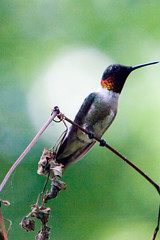
Watching these birds for several hours, one can see patterns emerge. This little male has several favorite perches. He prefers a tiny twig that is fairly long relative to his body size. The twig must give him a clear view of his domain. He is very possessive of his space. So he stays very busy chasing off would-be dinner guests. Thus the darting behavior.


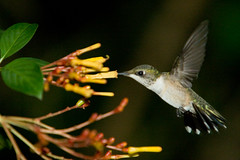
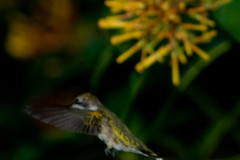
Then came the female. She was allowed to feed when he was not in the neighborhood. It is my suspicion that he was out visiting his other girlfriend next door when I was able to catch some photos of this little lady.

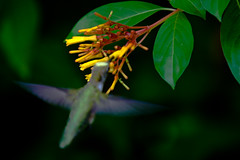
For the next couple of days, she was running off the others until the guy returned and chased her off. She fed more inside of the Hummingbird plants than did the male. She did not get up on the perches and monitor the area like he did. She would just attack everything that came to the table while in the backyard, then would disappear for as long as an hour. The female tended to catch more insects than the male. She would be high in the air at times, obviously catching something about 20-30 feet off the ground. That could have been flies or mosquitoes.

These are Ruby-throated Hummingbirds. They are the dominant and possibly only one of two species in this area. The other species is the Rufous. These Ruby-throated nest right here in our backyards. I suspect this one has a nest near here and is feeding her brood now, but she managed to keep me unaware of her nest. According to my bird book, she can be nesting as far away as 1.3 km and feeding here in my backyard. I noticed that each time she arrived, I could hear her chattering as if to say, "if there is anyone else here, you'd better leave".

Don't think that the little lady is dull and only gray with white wing tips. She has the iridescence on her feathers that is typical of Hummingbirds. When the light hits her just right, you see these green and blue colors. As the sun reflects off of the bird in the flowers, her colors become very evident. The female is quite beautiful in fact.

So the next time you go outside and have the opportunity to observe these beautiful and interesting creatures, try to see where the male is watching and if there are any females lurking around. Keep an eye for a family, maybe two youngsters and their mama. The male does not play a role in the upbringing of the brood. The female will protect them, but after a couple of weeks out of the nest, she will run them off to fend for their own well being, unlike the broods of other backyard birds.

Montgomery County had two observers participating in the 2006 Texas Hummingbird Roundup, reporting two species of Hummingbirds in the county.


Video:


References


  1. Species of East Texas - Texas Parks and Wildlife
  2. Identification of Hummingbirds - Texas Parks and Wildlife
  3. Texas Roundup of 2006 - diversity of sightings